Complete Guide
Production
To produce and direct Red Dwarf, Doug, Rob and Paul selected Ed Bye. All three had worked with him before, and Ed was keen to take on both roles - as has become his standard practice - in order to keep hold of the reins. The series was shot at the studios of BBC Manchester, which meant that episodes had to be 'blocked' at the rehearsal rooms in Acton. Tape on the floor represented the basic layout of the set, with the additional basic chairs, tables and bunk beds brought in.
Unexpectedly, it was Norman Lovett who proved to be the cast prankster. Graffiti was found under the upper bunk-bed of the rehearsal room reading 'Norman Lovett was here for quite a while'. He also had a small football confiscated by Assistant Floor Manager Dona DiStefano when the cast found themselves distracted from rehearsing by an impromptu game of footy.
On the second day of rehearsals, an electrician's strike began at the BBC which effectively put a stop to any production. Unperturbed, the crew completed rehearsals for the first episode and moved on to the second, optimistic that they could fit the The End shoot onto the end of the other existing episode slots.
Except one by one, the episode recordings were called off as the strike persisted. The entire season, rehearsed and ready, was left for six months - past the originally intended dates for broadcast - before being remounted. (Interestingly, Rob Grant had made noises about going solo during the tribulations.)
Shooting at BBC Manchester consisted of a pre-record/rehearsal day on the set, followed by the shoot before a live audience. It was this audience that proved most difficult during series I - Doug Naylor was apparently to be found grabbing people out of the pubs in the vicinity to up the numbers!
In fact, the writers were so anxious that the audience would 'get' what was going on that they would give a run-down of the plot - cat evolution, holograms - before each recording. With the audience staring blankly back, they remain unsure as to whether it actually did any good. Eventually Holly was given the job of recapping at the start of each episode, along with a snappy one-liner. At the other end of the show, both Future Echoes and Waiting for God featured additions to the 'standard' credit sequences.
One idea was to have the crew of Red Dwarf made up of well known comedy stars, only to kill them off and leave them with 'Craig who?' This was rejected, only for the first episode's 'guest star' to prove difficult enough. The cat playing Frankenstein would not sit still for anyone, and multiple takes of the scene where Lister talks to her about Fiji had to be done.
With a successful take in the bag, the crew moved on - unaware that their 'successful take' actually featured a cameo appearance by Craig's testicles! A previous, inferior take in which Craig spilled the milk he was pouring was eventually used, the suggestion being that Lister is just that slobby. (The Future Echoes babies caused another change when they wouldn't cease wailing and the 'Stop crying...' line was added.)
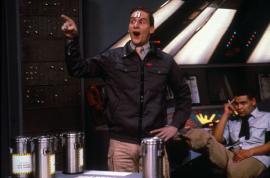
Another scene was excised entirely when it proved not to be up to scratch. Lister ejects the remains of the crew (in their silver cylinders) into space. Or rather, he drops them into a pedal bin. The shoddy effect ruined any poignancy that the scene might have had, and so it was removed - along with Rimmer giving his own eulogy (apparently he used to attempt to touch women's breasts by 'accident' - a process he called 'elbow-titting').
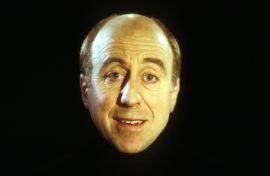
A further change was even more drastic. Originally conceived as being just a voice-over, Norman Lovett had campaigned vociferously for Holly to be a visual role, and himself suggested that the computer should be a disembodied head on a screen. This decision, made before the third episode recording, meant that The End and Balance of Power had to be re-edited to include him. Certain scenes - Lister meeting the Cat for the first time, for example - were, in fact, re-shot in line with this development.
But the show's SF nature was also causing its share of headaches. With the science of Future Echoes baffling everyone (Ed Bye was to be found lying on the floor to get his head around it), the writers introduced Rimmer's comedy haircuts - revenge from Holly - to get in a few extra laughs. However it was Ed's blocking - the 'choreography' if you like - of the famous double scene that eventually made sense of the script's idea.
Elsewhere, the realities of production made things more difficult. Lister's impending doom, it was felt, didn't have the emotional impact it could have - a problem suffered by the whole season. Still, in what would become a trademark trait, Craig was more than willing to do his own stunts as sparks were set off around him.
The flashback sequence in Balance of Power was, at one point, indicative of where Rob and Doug were aiming to take the show - a lonely guy recalling his lost past - although this was eventually abandoned. (They'd also toyed with the idea of non-addictive cigarettes!)
Late rewrites on Waiting for God meant that Noel Coleman struggled almost endlessly with his dialogue, but the episode did at least feature Ed Bye's favourite, the Toaster. Not yet named 'Talkie', the Toaster did not survive to the second season, much to Ed's chagrin. In spite of this development, it was once suggested that the Toaster might take over the ship!
Further trouble from slightly more animated life-forms came from Confidence and Paranoia's fish rain. Dead fish were slung from above the set, whilst live ones were carefully placed on the ground (and in Lister's bunk). No fish were harmed during the production - although they did stink up the set something rotten.