Complete Guide
Effects
Mike Seymour had been on the books for the Red Dwarf movie (which, at one point, was slated to shoot in Australia), and - by sheer coincidence - his name came up again when Doug Naylor was looking for some help figuring out the Red camera workflow. Talk about destiny!
Mike's FXPHD - an online education scheme for effects artists - brought a remarkable deal to Red Dwarf, one that brought in animators and artists from all over the world... most of whom worked from home, rendering CGI shots and uploading them for approval. A mere 25 people doing the work of a hundred.
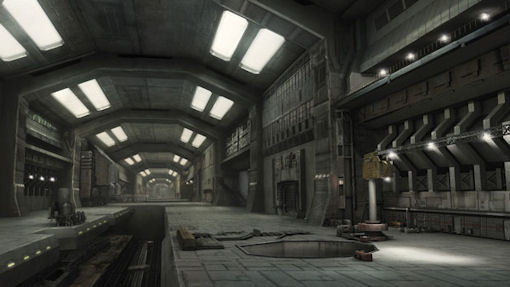
In co-operation with Fin Design, the G-Deck location was created. A cavernous area with access to one of the ship's massive water tanks, this was Back to Earth's biggest 'virtual set'.
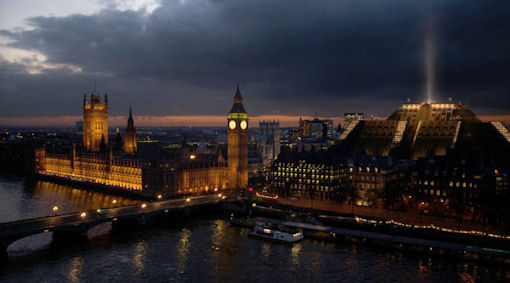
In the end, there were 262 effects shots created - some of which you'll never even notice. Every monitor you see - including the dozens in the department store - is showing a picture that was laid in later. When The Creator fires his gun at the Dwarfers, the gun's slide kicking back and the bullet cases popping out were all added later. When the Cat tosses a vase over his shoulder onto the creator... well, nothing ever got thrown on-set.
It's the kind of detail that would never have been possible during Red Dwarf's last production - and
something that can, in fact, save time on-set, where We can fix it in post
becomes a relieving mantra
for a project on an insanely tight turnaround.
With the team unable to afford an animatronic skutter - even to refurbish the shell of the existing pair - once again it was FXPHD to the rescue, with Matt Graham (famously working for no more than a signed copy of the script) animating the virtual droid. The moves were based in part on hand-puppet movements captured on set, performed by one Danny John-Jules. Though the base of an original skutter was used on-set where possible.
Back to Earth really covered the gamut of effects work. From the swirling dimension portal - which grows larger and larger throughout the sequence and interacts with the greenscreened cast - to three-dimensional corridors. Created for the portal sequence were three virtual 'ragdolls' of Cat, Kryten and Lister - 3D puppets of the characters, based on reference photographs, that allowed them to be tossed through the air without damaging the actors.
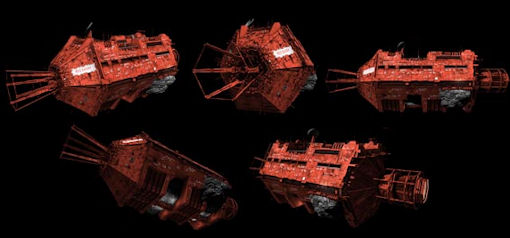
Out in space, a new Red Dwarf ship was built. Based on the existing CG elements used by Chris Veale for the Series VIII (and remastered) ship, the team brought the shape back to the original 'stubby' version by... well, chopping the back end off the smegger. It was a more complex process, though, with the front scoop, rear engine and much detail having to be reworked to better match the original.
It was also decided to correct a 'film grammar' error that had plagued the show since it began: 'returning home' is a right-to-left journey across the screen, but in the series it had always been shown heading left to right - essentially an 'outbound' journey. This change threw up one question, as the embedded meteor in the ship would technically be switching sides. But, since the ship must have changed shape since it was last seen in Series VIII, it was felt there was bound to be a reason for this. (Our money's on something that involves the mirror universe...)
While the main ship model couldn't be shown close-up - there was no time or money for the kind of work it would take to layer in that kind of detail - one ambitious shot did push in from a specially-created exterior section, though a window to watch Lister walking along a (virtual) corridor.
Back in three dimensions, practical elements were built by Dean Brooks and his company - casting rubber tentacles, augmenting a Smart Car with flowerpots, lights and decals to create Carbug, putting together an array of guns and building the dimension cutter.