Complete Guide
Writing
When Doug Naylor sat down to write the tenth series of Red Dwarf, he had the unenviable task of writing a full set of six episodes of the show single-handedly for the first time ever. When it came to the next series, however, the task was even more daunting: not six new episodes, but twelve.
This created a scenario that had never before been presented to a Red Dwarf production: the possibility that the first six episodes written and recorded might not actually end up being the six that made up the first series of the two being produced. Although this wasn't known to the fans who would see each episode recorded, there was to be no "arc" running through the series - nor even much at all in the way of recurring plot points. Every episode was completely standalone, enabling the series' internal order to be shuffled around even after it was decided that the "XI" and "XII" blocks would, after all, remain separate from one-another.
First in the original order was Give and Take, an episode that drew on some distinctly Series V vibes by blending comedy with horror - the demented droid Asclepius proving a truly terrifying creation. The episode's second half involved some particularly headache-inducing time-travel, kidney-snatching shenanigans, marking it out as one of the cleverest Red Dwarf episodes of recent years; while the friendly (and genius) snack dispenser Snacky was an instant hit; although despite remaining on the ship at the episode's close, he's yet to make a return appearance...
Can of Worms, the second recorded but written later in the process, was a rare Cat-centric episode that also ended up being a second sequel to Polymorph - but unlike Emohawk: Polymorph II, the surprise was preserved by keeping it out of the title and all pre-publicity! As with Back to Earth's Joy Squid, the episode put a distinct spin on a previous concept by introducing the female version of a previously-established species.
Krysis was another episode that called on past lore, by introducing us to another member of Kryten's Nova fleet - the Nova 3, and its service mechanoid Butler. This exploration of Kryten's "mid-life crisis" saw Red Dwarf taking advantage of its rare status as a show that has lasted for nearly three decades with the same characters; and Kryten's new "chassis" played on the car obsessions of both Robert Llewellyn (electric) and Chris Barrie (petrol).
There were also echoes of Legion in the way the crew encountered Butler's artistic and intellectual superiority, while the final act upped the stakes in a way the show had never done before, by literally introducing us to the voice of the universe.
The only episode of the series to take place predominantly aboard Red Dwarf itself, Officer Rimmer showed once again that the only thing worse than one Rimmer is several of them. But the character was shown to have learned from his experiences in Me2 and Rimmerworld, by only being happy to have a ship filled with clones of himself if he clearly outranked them. This was a very early-series-style character piece, while the "Bio-Printer" jokes made for an amusingly Dwarf-ish take on a modern technological annoyance.
The fifth episode recorded - but moved to second in the broadcast order - Samsara was essentially a "bottle" episode, designed to free up budgetary resources for elsewhere in the series. Originally titled Lift Off, it was intended to involve the characters being stuck in malfunctioning lifts - and this was where the majority of the Cat/Lister "Archimedes" dialogue had its origins.
But the "karma drive" concept was considered too good to waste on a dialogue-heavy, low budget episode; and so the idea expanded to include the unique, parallel "three million years ago" storyline - creating the unusual scenario of a set of characters who appear throughout the episode but never interact directly with the Dwarf crew.
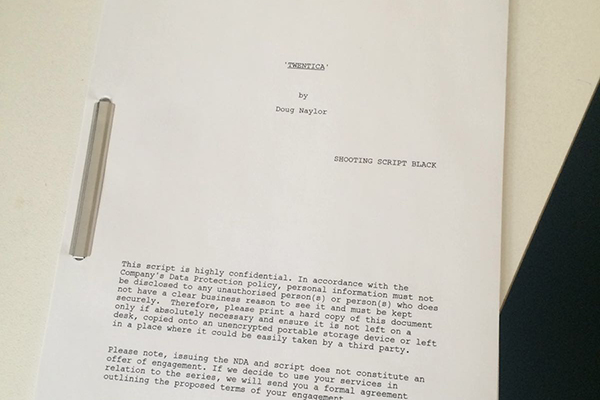
Produced last out of the six, but brought to first in the broadcast order as a showcase for the new scope of the show, Twentica was one of the most ambitious Red Dwarf episodes ever attempted. Taking place almost entirely in an alternative 1950s USA, it was able to mine huge amount of humour out of its "science is banned" premise. There was also another new addition to Red Dwarf's universe of malevolent droids, with the smartly-named Exponoids - Simulant-like creations whose intelligence doubles constantly with time.
With every single episode featuring guest characters and new sets and locations, the six scripts that made up Red Dwarf XI would be one of the most challenging ever to produce. But would we have it any other way...?